Histories
The Promenade Concert Orchestra’s repertoire draws on a rich tradition of British light orchestral broadcasting. Here are the stories behind some of the programmes, concerts and traditions that shaped the music we perform today.
Your 100 Best Tunes
Viennese Concert
Music While you Work
Housewives Choice
Palm Court

Your 100 Best Tunes
The radio programme Your 100 Best Tunes ran for 44 years, starting in 1959. Alan Keith devised and presented the programme for most of that time, offering listeners generally light and undemanding classical pieces. He chose the original 100 pieces himself, but in later years listeners periodically voted the selection on.
Alan Keith OBE (born Alexander Kossoff, elder brother of the well-known actor David Kossoff) was born in 1908 and died in March 2003. He was a British actor, disc jockey and radio presenter, noted as the longest-serving and oldest presenter on British radio at the time of his death, aged 94.
Born and educated in London, he changed his name to Alan Keith in 1926 and by 1928 was appearing in the West End and on Broadway, a career that lasted eight years. By 1935 he was already an established voice on BBC radio, appearing in dozens of radio plays and spending three years as an interviewer for In Town Tonight.
In early March 2003, at the age of 94, he recorded an announcement that he intended to retire from the programme after 44 years. However, he fell ill almost immediately and died soon after; his final broadcast went out 12 days after his death.
I can still hear his distinctive voice and signature tune — many years after listening to the programme — starting on an Ecko Bakelite wireless set in the early 1960s and ending on hi-fi stereo! The Grand Hotel with Tom Jenkins was also a favourite in our house, along with Sing Something Simple! Those were the days!
— H. Rogerson

New Year Viennese Concert
One of the most famous concerts in the world, the Vienna Philharmonic Orchestra’s New Year’s Day Concert from the Golden Hall of the Vienna Musikverein dates back to 1939. That first concert was the only one not held on New Year’s Day itself, but on 31 December. Clemens Krauss conducted, and Johann Strauss II was the only composer performed. The concert was preceded by a public dress rehearsal the day before, and it has since become traditional to hold a public dress rehearsal on 30 December, a New Year’s Eve concert, and the New Year’s Day morning concert, which is now televised in more than 50 countries.
For the first 15 years the conducting was shared between Krauss and Josef Krips, then Willi Boskovsky conducted every year until 1979. Lorin Maazel, another maestro equally at home with a violin in hand, took over until 1986, and in 1987 the great Herbert von Karajan took to the podium on New Year’s Day for the only time. Since then the baton has passed annually between renowned international maestros — among them the Venezuelan conductor Gustavo Dudamel, the youngest to have conducted the concert, who also leads many other international orchestras, including the Simón Bolívar Youth Orchestra, which has performed at the Proms in London.
The programme always includes pieces from the Strauss family (Johann Strauss the Elder and his sons Johann, Josef and Eduard), with occasional works by other, mostly Austrian, composers. The compositions are usually waltzes, polkas, mazurkas and marches. Around a dozen pieces are played, plus encores, with the complete concert, including intervals, lasting around two and a half hours. The first radio broadcast was in 1953, the first television broadcast in 1959, and the first Eurovision broadcast in 1969.
Encores were not introduced until 1945. Today it is traditional to end the concert with three: a fast polka, followed by The Blue Danube, whose opening bars are interrupted by applause of recognition from the audience. The musicians then collectively wish the audience a happy new year before playing the waltz, and close with the Radetzky March. During this final, festive piece, the audience claps along, and the conductor turns to face them, conducting the audience instead of the orchestra.
Surprisingly, The Blue Danube was only introduced to the programme as an encore in 1945, and the Radetzky March followed in 1946, also as an encore. There have been occasional exceptions to the closing tradition: in 1967 Willi Boskovsky made The Blue Danube part of the main programme, and in 2005 Lorin Maazel closed his concert with it (omitting the Radetzky March) as a mark of respect for the victims of the Indian Ocean earthquake and tsunami.
The flowers that decorate the hall are traditionally a gift from the city of Sanremo, in Liguria, Italy, though in some years the gift has come instead from members of the Vienna Philharmonic itself. The orchestra is joined by ballet dancers from the Vienna State Opera in pieces during the second half of the programme.
The concert is so popular around the world that people must register a year in advance to enter the ballot for tickets, and some seats are held by Austrian families and passed down through the generations.
— Jean Ball
Music While You Work
In 1939, with the outbreak of war, the BBC’s National and Regional programmes merged into a single Home Service, broadcasting largely on the BBC’s own musical resources. After the war, the Light Programme launched in 1945 to carry entertainment, while the Home Service became increasingly a spoken-word service, eventually evolving into Radio 4.
The War Department suggested to the BBC that regular daily programmes of uninterrupted music would boost morale, and therefore production, in the factories. On 23 June 1940, the Radio Times carried this announcement:
‘This coming week there will be, twice every day, half an hour’s music meant specially for factory workers to listen to as they work. You will find it in the programme pages for each day under the title Music While You Work!’
Dudley Beavan played the first edition of Music While You Work on Sunday 23 June 1940 at 10.30am on the theatre organ, followed by a second edition at 3pm performed by a group called the Organolists.
Over the years the BBC tried many formulas for the programme, but what the factories wanted was tuneful, unpretentious and predominantly familiar music that workers could sing or whistle along to as they worked. Various signature tunes came and went until, in October 1940, Eric Coates’ new march Calling All Workers was adopted.
The programme soon settled into a twice-daily, seven-days-a-week slot, featuring many different bands, orchestras and theatre-organ soloists from all over the country. It was felt the music should be neither too lively, in case it caused accidents at work, nor too distracting, for fear of loss of concentration — modern slow waltzes were banned for their ‘soporific’ qualities, and nothing ‘lethargic’ was permitted. The volume had to be sufficient to be heard over machinery noise, but not loud enough to demand attention, and pieces were played segue, without intervals or announcements, linked by a regular beat, with nothing too virtuosic or elaborately orchestrated.
Eventually the programme was broadcast three times a day with repeats, entertaining workers around the clock. Many conductors, bandleaders and orchestras took part over the years, and factory owners reported increased production when the programmes were on air.
The original series ended in 1967, but was revived for a week in 1982 to mark the BBC’s Diamond Jubilee. Public demand following that revival led to the programme being reinstated on a daily basis in 1983. Soloists, used in the wartime broadcasts, did not feature in the revival; and while the original programmes were live and audition-based, the revival was pre-recorded in the studio using non-audition bands — a policy that did not always succeed, with some bands’ recordings never broadcast, or not repeated. This revival lasted a year.
A further revival followed in 1990, marking fifty years since the first broadcast, and a one-off programme in 1995 with Victor Silvester Jnr and his orchestra brought the story to a close after fifty-five years.
‘Music While You Work meant a great deal to many people, not least to the musicians involved. It was an unforgettable programme, truly an era in broadcasting.’
Much of what is known today about the programme’s history comes from Music While You Work – An Era in Broadcasting by Brian Reynolds, who meticulously researched and documented its full story.
— Howard Rogerson

Housewives’ Choice
This popular programme on the BBC’s Light Programme ran from 1946 to 1967. Part of the post-war drive to encourage and support people at home and at work, it offered a wide range of music aimed at housewives listening during the day. With little competition, it built a large and loyal audience.
Its signature tune, In Party Mood, was composed by Jack Strachey. Presenters, known as ‘compères’, changed each week, though George Elrick was a regular compère and even wrote lyrics to the signature tune.
The programme was replaced by Family Choice, which ran until 1970.
The Palm Court
In 1952–53 and 1953–54, violinist Tom Jenkins won the Daily Mail National Radio Award for Most Popular Musical Entertainer, based on a poll conducted across a wide section of the listening public covering both radio and television. With an estimated fifteen million listeners in the 1950s, it is hardly surprising that the star of The Grand Hotel Palm Court Orchestra should receive such recognition. Around the same time, the Palm Court Orchestra celebrated its 450th broadcast — a measure of just how popular light orchestral music was at its height, with the BBC’s Light Programme employing many orchestras and ensembles across long hours of daily broadcasting. Tom Jenkins himself was born in south Leeds and moved to Morley at the age of two, and had already made a name for himself as a soloist by his early teens.
Musicians such as Albert Sandler, Reginald Leopold, Max Jaffa, Albert Sammons, Eric Robinson, Frank Gomez and Stanford Robinson became household names through the wireless and 78rpm recordings — the four-minute length of most light music compositions fitting neatly onto these discs.
Long before this mass broadcast medium, however, light music was already a great part of England’s spa towns and seaside resorts. Many such towns offered live music in forms ranging from trios to full orchestras, directed by names as great as Adrian Boult, Malcolm Sargent, Henry Wood, Thomas Beecham, John Barbirolli, Basil Cameron, Dan Godfrey and Jean Rivière, among others.
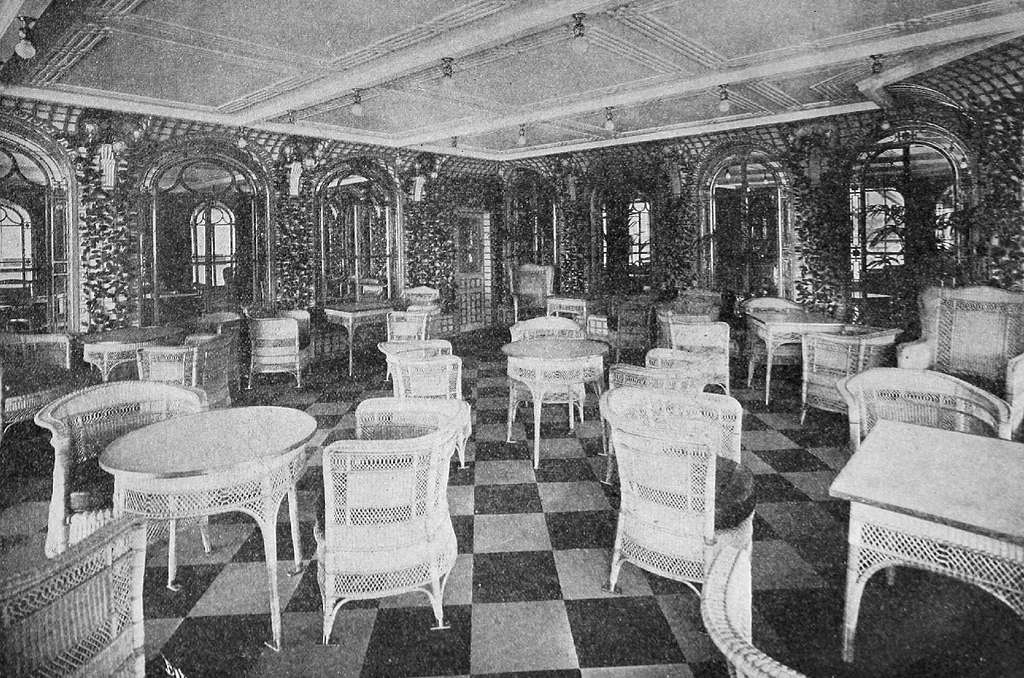
The Palm Court itself was, quite literally, that: a descendant of the court musical entertainments enjoyed by the wealthy in the seventeenth and eighteenth centuries, carried through to the railway-travelling public of the nineteenth, where live music flowed through the great palaces of entertainment, surrounded by palm trees, aspidistras and the like.
Many composers met the demand for this popular music at the time, and though most of their names have faded, their melodies live on. From the 1930s to the 1950s, the wireless and gramophone recordings revived interest in light music through composers such as Eric Coates, Robert Farnon, Vivian Ellis, Ernest Tomlinson, Ronald Binge and Percy Fletcher, with later figures such as Carl Davis and John Williams carrying the tradition forward.
The music the orchestra performs is drawn largely from its conductor’s extensive and still-growing library, gathered over almost fifty years from places where orchestras once thrived — Blackpool Winter Gardens, Torquay, Swansea, Birmingham, Settle, Bournville, Hull, Leeds, Harrogate, Morley and many more — with some pieces unplayed for decades. The most recent addition comes from the conductor’s home town of Morley, Yorkshire, where his mother’s cousin’s wife’s father — Ted Barham — ran an orchestra for many years. This collection alone runs to more than 350 pieces, dating from the early 1900s to the 1950s, including pre-First World War German pieces and dance-band numbers featuring saxophones. Ted Barham’s brother-in-law, Johnny Speight, was Howard Rogerson’s first clarinet teacher, in 1959.
The Promenade Concert Orchestra performs in Morecambe as a large orchestra, whereas Palm Court ensembles were often much smaller — Tom Jenkins’ own Palm Court Orchestra at The Grand Hotel had just eight string players and a Mustel organ to stand in for the wind and brass, with the piano often used for the same purpose. The PCO is the only full-size concert orchestra in the country regularly performing this historic Palm Court repertoire.
— H. Rogerson
Book one of our Performances
TICKETS
Terms & Conditions
Tickets
Ticket Policies
The Platform
Events
Contact Info
About
Privacy Policy
Accessibility
Site Map
Contact
GET INVOLVED
Support Us
Sponsor Us
Become a Friend